- Home
- Products
- About Us
- Services & Support
- News
- Contact Us
Views: 0 Author: Site Editor Publish Time: 2025-10-31 Origin: Site


Application Characteristics of Belt Sludge Dewatering Machines and the Relationship Between Sludge Moisture Content and Chemical Dosage;
Application Characteristics of Belt Sludge Dewatering Machines and the Relationship Between Sludge Moisture Content and Chemical Dosage; As a key piece of equipment in wastewater treatment systems, belt sludge dewatering machines are widely used in municipal wastewater and industrial wastewater treatment due to their high efficiency, energy saving, and ease of operation. Their core principle is to convert diluted sludge with a moisture content of over 95% into dry sludge cakes with a moisture content of 60%-85% through a combination of gravity thickening and pressing dewatering, thus reducing sludge volume and laying the foundation for subsequent disposal. As a core piece of equipment for end-of-pipe sludge reduction in wastewater treatment systems, belt sludge dewatering machines have become the mainstream choice for sludge treatment in various industries, including municipal wastewater, chemical, food, and dyeing, thanks to their outstanding advantages of high efficiency, energy saving, ease of operation, and strong adaptability. Its core value lies in transforming the diluted sludge, typically with a moisture content of 95%-99%, generated after wastewater treatment into dry sludge cakes with a moisture content of 60%-85% through an integrated process of "flocculation conditioning + gravity thickening + pressing dewatering." This significantly reduces the sludge volume (the volume after dewatering is only 1/10-1/5 of the original volume), clearing a key obstacle for subsequent landfilling, incineration, or resource utilization (such as organic fertilizer production). Compared to plate and frame filter presses, it eliminates the need for frequent start-stop and cake unloading, increasing continuous operating efficiency by over 30%. Compared to centrifugal dewatering machines, its energy consumption is reduced by approximately 40%, and it operates with lower noise, significantly reducing maintenance difficulty.

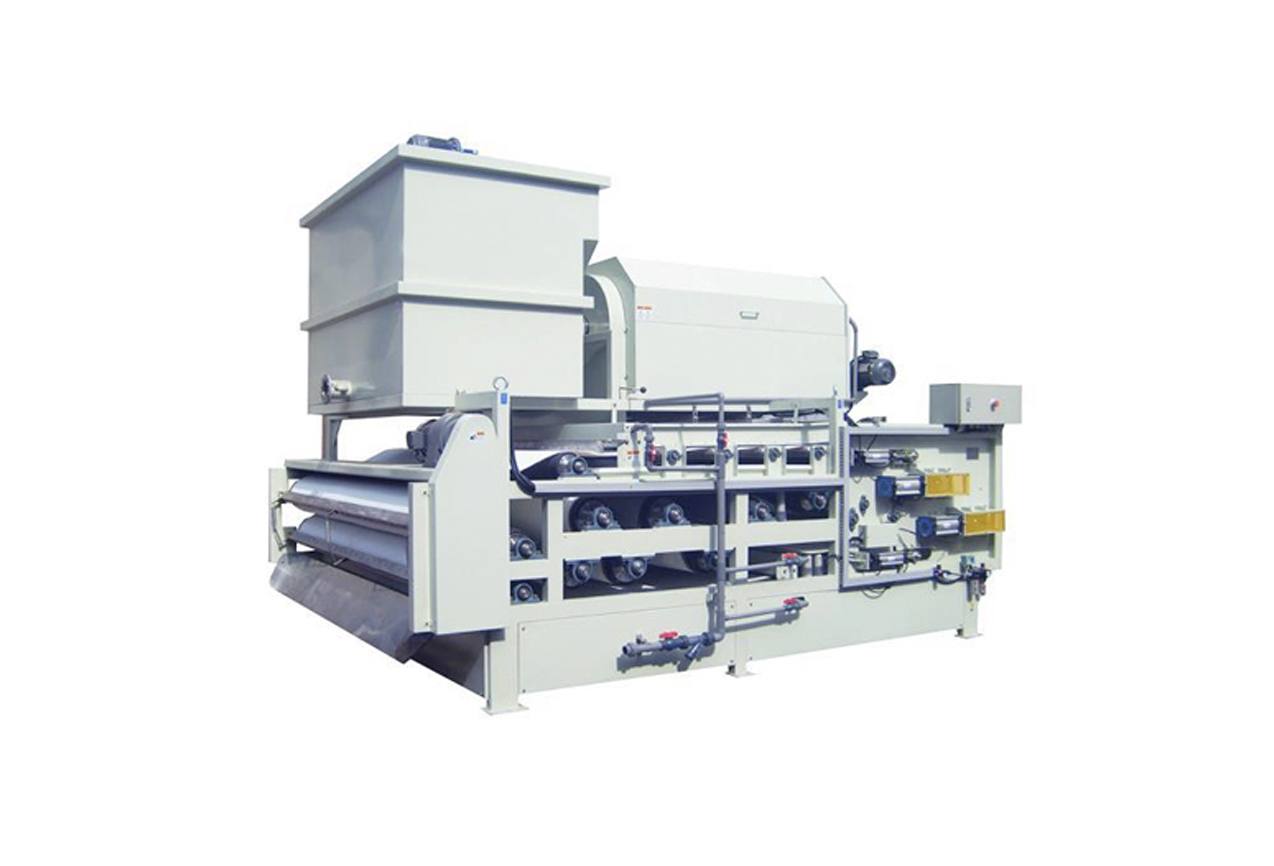
The equipment mainly consists of a feeder, a gravity dewatering zone, a pressing dewatering zone, and a filter belt cleaning system. After being conditioned with flocculant, the diluted sludge enters the distributor and is evenly spread on the filter belt. In the gravity dewatering zone, free water drips naturally through the gaps in the filter belt, reducing the sludge moisture content to 85%-90%, forming a plastic sludge layer. It then enters the pressing zone, where rollers squeeze the upper and lower filter belts, further squeezing out the capillary water from the sludge layer, ultimately forming a dry sludge cake that is discharged. The entire process is highly automated, with a single unit processing capacity of 10-100 m³/h, adaptable to different scale processing needs. Stable operation of the equipment relies on the coordinated operation of various systems. Its core structure includes a flocculation and mixing system, a distributor, a gravity dewatering zone, a pressing dewatering zone, a filter belt drive system, and a cleaning system. At startup, the diluted sludge first enters the flocculation and mixing tank, where it is thoroughly mixed with a quantitative amount of flocculant to form a tightly structured floc—this step is crucial for effective dewatering. Subsequently, it is evenly spread on the slowly moving filter belt by the distributor, preventing uneven dewatering caused by excessively thick localized sludge. In the gravity dewatering zone, the filter belts are arranged at an angle and rely on gravity to allow free water in the flocs to quickly drip through the gaps in the filter belts, initially reducing the sludge moisture content to 85%-90%, forming a plastic sludge layer with a certain strength. The sludge layer then enters the pressing dewatering zone with the filter belts. The upper and lower filter belts form a compression gradient between a series of rollers of different sizes, gradually squeezing out the capillary water in the sludge layer from low pressure to high pressure, ultimately stabilizing the moisture content within the target range and forming a dry sludge cake, which is collected by the cake unloading device. It is worth noting that the filter belt cleaning system needs to continuously flush the residual sludge in the filter belt gaps under high pressure. Incomplete cleaning will lead to filter belt blockage, directly reducing dewatering efficiency; this is a critical aspect of operation and maintenance. Currently, mainstream equipment can handle 10-100 m³/h per unit, and multiple units can be connected in parallel to meet the massive sludge treatment needs of large-scale wastewater treatment plants.

The relationship between sludge moisture content and chemical dosage is a core control point for equipment operation; the two exhibit a non-linear negative correlation. When the initial moisture content of sludge is high (e.g., 98%-99%), sufficient flocculant is needed to form dense flocs from the sludge particles, reducing the amount of free water trapped within them. Taking municipal sludge as an example, with an initial moisture content of 97%, a polyacrylamide (PAM) dosage of approximately 2-3‰ can reduce the moisture content after dewatering to 75%-80%. If the dosage is insufficient, the flocs will be loose, and the sludge and water will easily separate during pressing, causing the moisture content to rise above 85%. The dynamic balance between sludge moisture content and dosage is a core technical aspect of belt dewatering machine operation control. The relationship between the two is not a simple linear one, but rather exhibits a non-linear pattern of "first decreasing and then increasing," and is significantly affected by the properties of the sludge. For sludge from different sources, the initial moisture content, organic matter content, and particle size vary considerably, resulting in drastically different optimal dosage ranges. Taking municipal sludge as an example, it has a high organic matter content (about 40%-60%) and small particles. The initial moisture content is usually 97%-99%. When the moisture content is 99%, 3-4‰ of polyacrylamide (PAM, mainly anionic) needs to be added to make the sludge particles fully flocculate and agglomerate, reduce free water encapsulation, and the moisture content after dewatering can be reduced to 70%-75%. If the initial moisture content is reduced to 97%, the dosage can be reduced to 2-3‰, and the dewatering effect can still be maintained at 75%-80%. However, if the dosage is insufficient, flocculation will be inadequate, resulting in loose and easily broken flocs. During pressing, the mud and water will separate again, causing the moisture content to surge to over 85%, and even leading to "sludge runoff." For industrial sludge, such as dyeing sludge (containing a large amount of fiber, with an initial moisture content of 95%-97%), the dosage needs to be increased to 4-5‰ due to the larger pores between particles. This ensures that the floc strength is sufficient to resist the pressing force, stabilizing the moisture content at 75%-80%.

However, more is not always better. When the dosage exceeds a critical value (e.g., PAM dosage for municipal sludge exceeds 5‰), excessive flocculant will cause the flocs to absorb too much water, reducing the dewatering effect and increasing both reagent costs and the burden on subsequent treatment. In actual operation, the dosage needs to be adjusted according to the sludge properties (such as organic matter content and particle size). The optimal dosage ratio should be determined through small-scale tests to achieve a balance between achieving the required moisture content and optimizing costs. More is not always better when it comes to chemical dosing; there is a clear critical value, and excessive addition can be counterproductive. When the dosage exceeds the critical value, excess flocculant molecules will form a hydrophilic film on the floc surface, causing the flocs to absorb a large amount of water. At the same time, excessive chemicals will increase the viscosity of the sludge layer, clogging the filter belt gaps and reducing filtration efficiency. For example, if the PAM dosage for municipal sludge exceeds 5‰, the moisture content after dewatering will actually increase from 75% to over 80%. For chemical sludge (containing many inorganic impurities, with an initial moisture content of 96%-98%), when the dosage exceeds 6‰, not only will the dewatering effect decline, but the cost of chemicals will also increase by more than 30%, and the residual chemicals in the dried sludge cake will affect subsequent resource utilization. Therefore, in actual operation, a process of "sludge property testing - parameter determination through pilot testing - dynamic on-site adjustment" needs to be established: by testing indicators such as sludge moisture content and Zeta potential, the optimal dosage range is first determined through pilot testing in the laboratory, and then the dosage is finely adjusted based on the moisture content feedback after on-site dewatering (usually by 0.5‰ each time). Simultaneously, adjustments should be made in conjunction with parameters such as filter belt running speed and pressing pressure. For example, when increasing the pressing pressure, the dosage can be appropriately reduced by 10%-15% to achieve the optimal balance between dewatering effect and operating cost.