
- Home
- Products
- About Us
- Services & Support
- News
- Contact Us


Fiber Disc Filter
Features of Fiber Disc Filters:
The fiber disc filter is an advanced, independently developed wastewater treatment technology, superior to other traditional processes. In today's society, advanced technology is the primary productive force, and it inevitably replaces outdated technology. The fiber disc filter technology is a masterpiece of this wastewater treatment era. Its most significant features are low operating costs, high and stable effluent quality, and a very small footprint. Compared with traditional processes, it has the following advantages:
1. High and stable effluent quality, meeting the national Class A standard. The backwashing intensity is 333 L/m.s, with a high backwashing frequency of once every two hours, preventing the growth of green algae and ensuring the filter cloth does not clog or harden. 2. The operating cost of fiber disc filters is extremely low, costing only 0.004 yuan (0.4 fen) per ton of water treated, while the operating cost of traditional processes (V-type filters, D-type filters, fiber bundle/ball filters) is 0.2-0.3 yuan. Taking 10,000 tons of water as an example, this translates to annual savings of 500,000-700,000 yuan.
3. Compared to traditional processes, fiber disc filters eliminate the need for a blower room, booster pump room, chlorination room, clear water tank, sedimentation tank, and other civil engineering works, resulting in a very small footprint. The footprint for 10,000 tons of water is only 15 square meters, which is 1/6 to 1/7 of that of traditional processes.
4. Fiber disc filters eliminate many structures, valves, and pipelines, making equipment maintenance and repair simple and convenient. The high degree of automation eliminates the need for dedicated personnel, significantly reducing the labor intensity of workers. 5. Compared to traditional filters, fiber disc filters eliminate the need for pre-chlorination, reducing operating costs and avoiding safety hazards for workers (high ClO2 concentrations can cause flash explosions, endangering worker lives).
Fiber disc filter technology is quite mature, and has been successfully applied in hundreds of wastewater treatment plants nationwide. This technology is gaining increasing recognition from enterprises across the country.
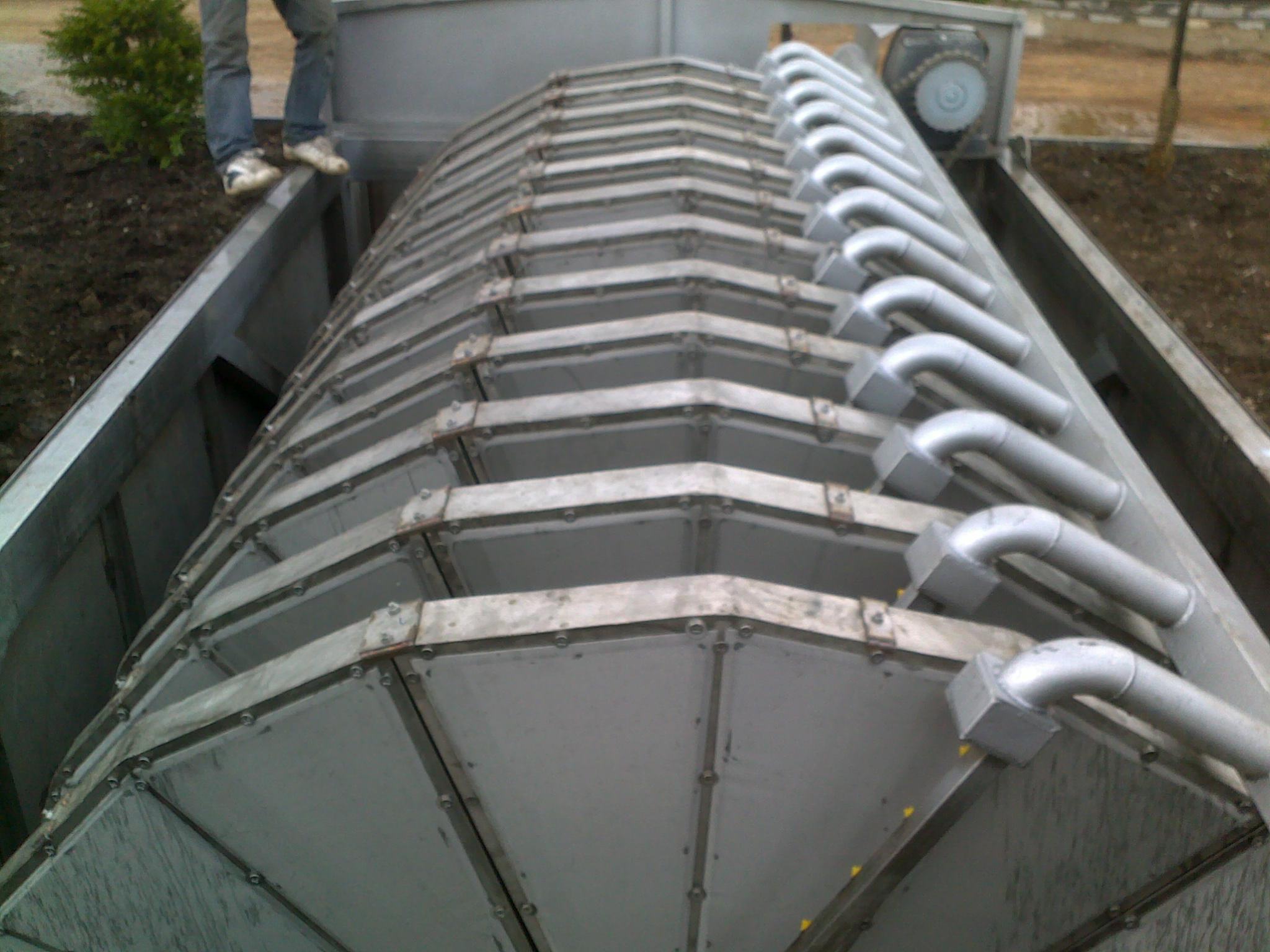
I. Filter Structure
The core component of the equipment is the central filter disc, composed of six fan-shaped panels covered with filter cloth. It features a pluggable structure, making transportation and maintenance particularly convenient. A drive motor in the upper right corner rotates the disc; the center of the filter disc contains a hollow central water collection cylinder; the backwashing device includes a back suction cup and a back suction pump; the sludge removal device includes a sludge pump (which also functions as a back suction pump), a hopper-shaped sludge collection trough with perforated sludge pipes; and an automatic control system (PLC automatic control panel). II. Working Principle of the Fiber Disc Filter
The operating states of the fiber disc filter include: filtration, backwashing, and sludge discharge.
(1) Filtration: Wastewater enters the filter by gravity, completely submerging the filter discs. A distribution weir is installed in the filter to ensure uniform water distribution and low disturbance during inflow. Wastewater passes through the filter cloth, and the filtrate is collected through a hollow pipe and discharged from the filter via the outlet weir. Filtration continues during the cleaning process. Therefore, filtration is continuous throughout the entire operation.
(2) Cleaning: During filtration, some sludge is adsorbed onto the fiber filter cloth, gradually forming a sludge layer. As sludge accumulates on the filter cloth, the filtration resistance increases, and the water level in the filter gradually rises. A pressure sensor in the filter monitors the water level change. When the water level reaches the cleaning set value (high water level), the PLC starts the backwash pump to begin the cleaning process. The backwash time and cycle can be adjusted. Sludge on the filter cloth is discharged into the plant's drainage system via a backwash pump after being suctioned out. During cleaning, the filter tank can continuously filter.
During filtration, the filter discs are static, which facilitates sludge deposition at the bottom of the tank. During cleaning, the filter discs rotate at a speed of 0.5–1 revolutions per minute. The backwash pump uses negative pressure to suction the surface of the filter cloth, removing accumulated sludge particles. Water within the filter discs is simultaneously drawn from the inside out, cleaning the filter cloth. The instantaneous rinsing area accounts for only about 1% of the total filter disc area, and the backwashing process is intermittent.
During normal cleaning, two filter discs form a group. One group is cleaned at a time, controlled by an electric valve on the automatic switching suction pump pipeline. The cleaning of each group alternates during a complete cleaning process of the fiber disc filter tank, while the suction pump operates continuously. When the influent water quality suddenly deteriorates and the backwash cycle is ≤15 minutes, the system will activate emergency measures, simultaneously starting 2-4 backwash pumps to backwash 2-4 sets of filter discs (4-8 discs) until the backwash cycle returns to normal.
(3) Sludge Discharge: The fiber disc filter has a bucket-shaped bottom, which facilitates the collection of sludge at the bottom. Sludge deposition at the bottom reduces the amount of sludge on the filter cloth, extending the filtration time and reducing the amount of backwash water. After a set time period, the PLC starts the sludge discharge pump, returning the sludge to the plant's drainage system through the perforated sludge discharge pipe at the bottom of the tank. The sludge discharge interval and duration can be adjusted.

In addition, if the pretreatment system before the filter malfunctions, the sludge discharge system can be activated to empty the filter. III. Unique Structural Design Features of the Fiber Rotary Disc Filter
This technology, developed through four years of experimental research and engineering trials at Tsinghua University, is now mature:
1. Filter Cloth Selection – Different filter cloths are selected for different water qualities.
2. Inlet Weir Design – Energy dissipation and low disturbance.
3. Adjustable Outlet Weir Design – Adaptable to different water qualities.
4. Filter Disc Design – Modular design.
5. Reverse Suction System Design – Low wear, preserving the filtration effect of sediment.
6. PLC Automatic Control System – Touchscreen display of operating status and time; single and double washing options available.
7. Design to Prevent Algae Growth


